
Scalable Intelligence
Augmenting Strategy: Unlocking the Enterprise Value of AI Integration
Artificial Intelligence has transitioned from an experimental capability to an operational imperative. However, the true return on investment (ROI) from AI lies not in standalone tool adoption, but in strategic workflow integration , combining machine precision with human judgment to convert organizational data into a continuous engine for predictive value creation.
Moving Beyond Efficiency to Strategic Value
While automating repetitive tasks provides immediate operational time savings, the core business impact of AI is realized when it fundamentally enhances decision velocity and executive strategy.
Task Automation: Reducing manual friction in operational and administrative workflows.
Augmented Decision-Making: Coupling data-driven algorithms with executive intuition to refine market forecasting and strategic investments.
Transformational Growth: Unlocking scalable business models and high-margin revenue streams previously constrained by data complexity.
Organizations that focus solely on cost reduction miss the primary value driver of AI: accelerating market responsiveness and competitive positioning.
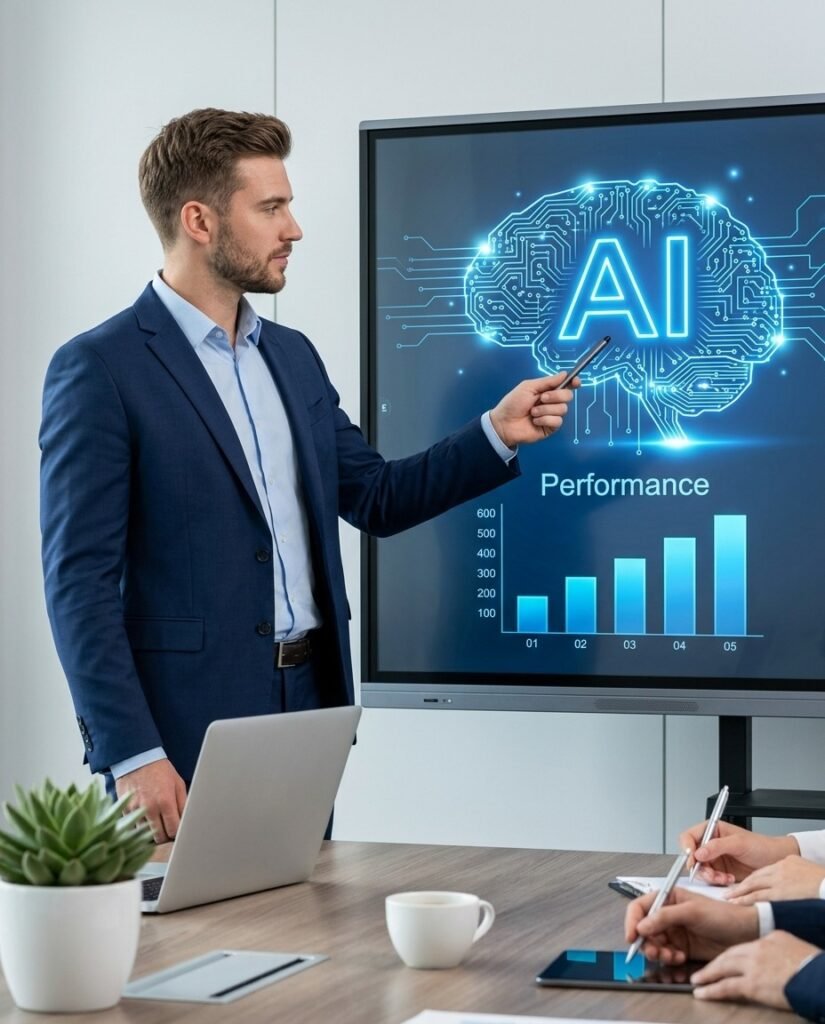
Enterprise Strategy
Strategic Pillars for Enterprise Scale
Successful AI adoption requires a structured foundation designed for security, governance, and adaptability:
Robust Data Governance: Establishing structured, secure, and unified data repositories—AI capabilities are directly limited by the quality of the underlying data infrastructure.
Human-in-the-Loop Frameworks: Designing workflows where AI scales analysis and insights, while human leaders retain oversight, ethical judgment, and contextual decision-making.
Workflow Re-Engineering: Rethinking core business processes around AI capabilities rather than layering new tools onto outdated operational frameworks.
.

Measuring Value Realization
To elevate AI from an IT expense into a strategic growth driver, leaders must evaluate metrics that reflect enterprise transformation:
- Traditional Focus: Number of tools deployed, license utilization, and tactical time saved.
- Strategic Focus: Decision-making speed, predictive accuracy in planning, customer lifetime value expansion, and time-to-market for data-backed products.

Transformation Essentials
Executive Takeaways
AI transformation is fundamentally a strategic model shift, moving organizations from reactive automation to predictive, data-driven leadership. Realizing its enterprise value requires aligning robust data governance with restructured workflows to scale human intelligence across every level of decision-making.
Strategic Augmentation
The true ROI of AI comes from scaling strategy and decision velocity, not just automating basic tactical tasks.
Data First
High-value AI integration relies entirely on robust data governance, clean infrastructure, and structured human-in-the-loop oversight.
Process Redesign
Sustainable enterprise transformation requires re-engineering end-to-end workflows around intelligence rather than adding tools to legacy systems.